
News Article
Meet the Team: Martin Kelm | Principal Structural Engineer – Offshore Wind Design & Engineering
The team at Longitude shares the passion, vision and values for working in energy and the world’s oceans – delivering design and engineering solutions to de-risk and drive sustainability in oil & gas, maritime and renewable energy.
You may know Longitude – but do you know the people behind the engineering?
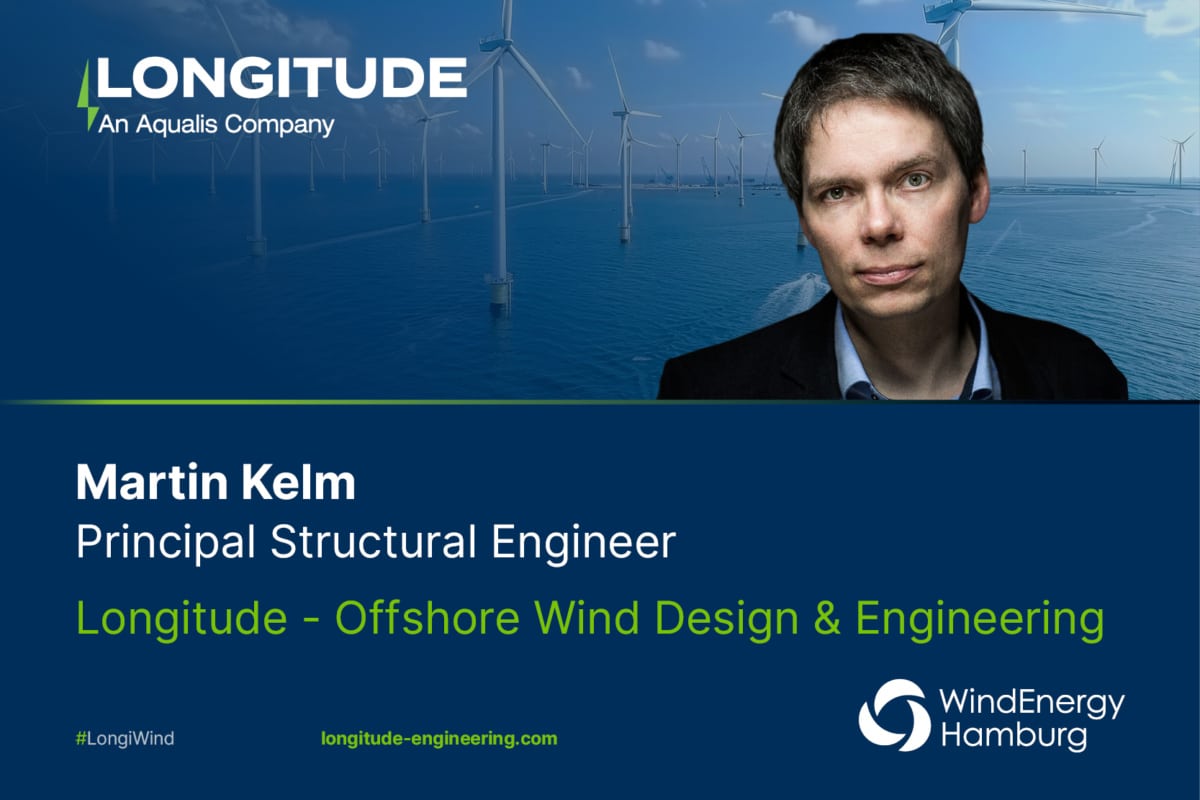
- Name: Martin Kelm
- Title: Principal Structural Engineer – Offshore Wind Design & Engineering
- Location: Hamburg, Germany
- Hobbies: Reading, programming and walking
- Favourites: Movie – Dead Poets Society, Book – Fatherland, Song – Sunday Bloody Sunday
Give us a glimpse into your day-to-day life at Longitude. What keeps you on your toes?
I enjoy working with people across the globe. Longitude (together with its sister companies) is a real international company and I am communicating every day with many different offices.
What drew you to the industry and what keeps you passionate about it?
Renewable energy is Germany’s and Europe’s only chance to be independent from fossil fuels, often imported and susceptible to geopolitical hostilities, and impacting our overall the resilience of our energy infrastructure. Further, the offshore wind industry is a relatively new industry with complex and very interesting technical solutions. There are many things to explore and develop.
Can you tell us about something exciting you are working on right now?
I am an engineer with a strong software focus. I am currently developing Longitude’s Monopile Designer, a software platform for designing monopile foundation for offshore wind turbines. I am quite excited to see it already applied in running projects bringing design efficiency and high quality to our customers. In this project, I can combine my main interests: explore new ideas and develop meaningful tools which make a difference and have a huge impact. As the software is very fast and efficient, it is ready for new applications beyond foundation design like wind turbine layout optimisations, probabilistic cost calculations and many more.
As Germany, Poland and other Baltic Sea countries accelerate offshore wind development, how can the right foundation concept and early-stage design decisions improve project viability, reduce risk and support more efficient fabrication and installation?
Early decisions have a large impact on a project’s economics and success. I am working in the industry for more than 20 years and I have seen successful projects and large cost overruns. Working on Longitude’ Monopile Designer and therefore being able to run efficiently and cheap many calculations as well as many design variants will provide better designs and a better basis for decisions to the industry. This will make project progress more reliable and bring down costs along the entire supply chain. Being able to handle foundation design complexity is even more important in mature markets like Germany and complex marine environments like the Baltic Sea.
The Baltic Sea offers relatively shallow waters, but that does not necessarily mean straightforward design. What site conditions and project interfaces must engineers consider when designing for offshore wind in the region?
The Baltic Sea is different in many ways from other marine environments. It shows strong winters and therefore a lot of ice which adds another dimension to the complexity of foundation design.